Equal Employment Opportunity (EEO)
Last updated: May 19, 2025
Equal Employment Opportunity (EEO) is a fundamental principle in contemporary human resources management that promotes fairness and equity in employment practices. It guarantees that all employees and job candidates receive equal treatment, regardless of their race, color, religion, sex, national origin, age, disability, or genetic information. Adhering to EEO regulations goes beyond legal compliance—it demonstrates an organization's commitment to building a diverse and inclusive workplace.
Key Metrics
Kula’s EEO report offers a thorough overview of your hiring process by tracking important metrics that help evaluate both compliance and diversity initiatives. The key metrics monitored include:
Applied: Total number of candidates who submitted applications.
Interviewed: Number of candidates who advanced to the interview stage.
Offered: Number of candidates extended job offers.
Hired: Number of candidates successfully hired.
Rejected: Number of candidates not selected at any point in the hiring process.
These metrics are further segmented by gender and detailed by:
Race: Breakdown of applicant demographics by race.

Veteran Status: Representation and outcomes of military veterans.

Disability Status: Participation and results for candidates with disabilities.

Date range
Analyze your recruitment pipeline over different periods:
Yesterday, 7 Days, 30 Days, 3 Months, 12 Months: Track short-term and long-term trends.
Custom: Define specific date ranges for tailored reporting.
Filters
Customize your reports using filters such as:
Job Name: Focus on specific roles.
Job Type: Analyze performance across full-time or contract roles.
Job Status, Department, Primary Recruiter, Hiring Manager: Drill down on pipeline details based on team, job status, or management.
Source, Location, Application Stage: Understand the impact of application sources, candidate locations, and Application stages.
Gender, Race, Veteran status, Disability status: Monitor diversity metrics to support your equal opportunity initiatives.
Functionalities
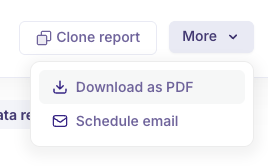
Download as PDF: Export and share your reports with stakeholders in a professionally formatted PDF.
Schedule Email: Automate report delivery at set intervals to ensure your team stays informed.
Clone Report: Easily duplicate existing reports for reuse or customization.
Refresh Date:

Indicates the last time the report data was updated, helping you ensure you're viewing the most recent insights. Our Analytics data will be refreshed every 6 hours.
Use Case
As a recruiter, you aim to hire the best talent while ensuring the hiring process is fair and inclusive. You want to make sure that candidates from all backgrounds have equal opportunities throughout every stage—from application to hiring.
Step 1: Monitor Overall Diversity in Applications
You start by reviewing the EEO report to see the diversity of candidates who applied for open roles. You check metrics broken down by gender, race, veteran status, and disability status to understand if your job postings are attracting a broad and diverse group.
Step 2: Identify Gaps or Bottlenecks in Hiring Stages
Next, you analyze how candidates move through the pipeline—who gets interviewed, offered a job, or hired. For example, if you see that female candidates are applying in good numbers but fewer are being offered roles, this could indicate bias or barriers at the interview stage.
Step 3: Use Filters to Drill Down
Using filters like job type, department, or location, you pinpoint whether the issue is specific to certain roles or regions. For example, you might find that candidates with disabilities are underrepresented in tech roles but fairly represented in administrative roles.
Step 4: Take Action Based on Insights
With these insights, you work with hiring managers to review interview practices, improve job descriptions for inclusivity, or increase outreach to underrepresented groups. You may also adjust recruitment sources to attract more diverse applicants.
Step 5: Track Progress Over Time
By regularly monitoring EEO reports over weeks or months, you track whether these actions improve diversity and fairness in your hiring process. Scheduled email reports help keep your team aligned and accountable.
Step 6: Report to Stakeholders
You export and share these reports with leadership to demonstrate your commitment to equal opportunity and diversity goals, supporting transparency and data-driven decision-making.
FAQs
Q: What is Equal Employment Opportunity (EEO)?
A: EEO ensures fair treatment of all candidates regardless of race, gender, age, or other protected characteristics.
Q: Why is EEO important in hiring?
A: It promotes diversity, inclusion, and compliance with legal regulations.
Q: What key metrics are tracked in EEO reports?
A: Applied, Interviewed, Offered, Hired, and Rejected candidates, segmented by gender, race, veteran, and disability status.
Q: How can EEO reports help recruiters?
A: They identify diversity trends, hiring gaps, and potential biases in the recruitment process.
Q: Can I filter EEO reports by job roles or departments?
A: Yes, reports can be customized by job name, department, location, and more.
Q: How often is EEO report data refreshed?
A: Data is updated every 6 hours to provide the latest insights.
Q: Can I schedule automated EEO report emails?
A: Yes, reports can be scheduled to be sent regularly to your team.
Q: Is it possible to export EEO reports?
A: Yes, reports can be downloaded as professionally formatted PDFs.
Q: How does tracking veteran and disability status help?
A: It ensures these groups are fairly represented and included in hiring efforts.
Q: Can I analyze EEO data over custom date ranges?
A: Yes, you can define specific periods for detailed trend analysis.